Executive Summary: Customer Experience Transformation Case Study
A global medical device manufacturer selected The Verde Group to lead a customer experience transformation initiative, conducting a comprehensive CX assessment across four major markets: the United States, Japan, China, and Direct International markets. The project’s goal was to understand how customer experience affects loyalty, repurchase intent, and financial performance, and to pinpoint specific friction points limiting growth. As the lead research and advisory partner, The Verde Group guided the initiative from start to finish.
The Verde Group’s research program combined qualitative executive interviews, journey mapping, and a global quantitative survey capturing 43 potential problem experiences across the end-to-end customer lifecycle. More than 900 completed and partially completed surveys were analyzed across markets, leveraging The Verde Group’s proven CX methodologies.
Findings revealed significant loyalty risk hidden beneath traditional satisfaction metrics. While Net Promoter Score (NPS) appeared stable, deeper behavioral analysis uncovered meaningful revenue exposure tied to unresolved friction in post-acquisition journey stages. The research ultimately quantified millions in annual revenue at risk and identified high-impact opportunities to improve retention, market share, and long-term profitability.
Business Challenge: Growth Pressure in a Competitive Global Market
The organization operates in a highly competitive global medical device market where customer retention, repeat purchases, and service contract renewals are critical drivers of financial performance. While internal metrics suggested generally favorable customer sentiment, leadership lacked diagnostic clarity into:
- Which customer experience problems most directly impacted repurchase behavior
- How CX performance differed across global markets
- Whether loyalty metrics correlated with financial outcomes
- Where investments would deliver the greatest ROI
Traditional CX metrics, such as NPS, were being used globally, but leadership questioned their consistency across cultures and their link to financial performance.
The Risk Beneath the Surface
Although NPS results appeared stable, further analysis revealed:
- A high percentage of revenue is concentrated among customers with low repurchase intent.
- Significant post-sale friction is impacting loyalty.
- Market-level inconsistencies in service recovery effectiveness.
- Cultural response bias influences attitudinal metrics.
The organization needed a more behaviorally grounded measurement framework that could link CX performance to economic risk.
Research Approach: Multi-Phase Global Methodology
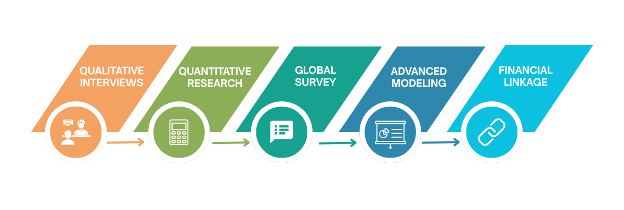
To provide actionable insights and a direct link between customer experience and business outcomes, The Verde Group designed a rigorous, multi-phase research program. This methodology combined qualitative and quantitative approaches to ensure a deep, market-specific understanding of the customer journey and drivers of loyalty. The process unfolded in three distinct phases:
Phase 1: Executive Interviews and Journey Mapping
The engagement began with a deep dive into the organization’s business context and customer journey.
- Interviews with nine senior executives
- External interviews with distributors and chain customers
- Review of journey maps and historical research
These insights informed The Verde Group’s development of a quantitative survey instrument tailored to the client’s global business.
Phase 2: Quantitative Survey Development and Deployment
Building on Phase 1 findings, The Verde Group crafted a robust survey to capture customer experiences and loyalty drivers at scale.
- The survey included 43 problem experience statements across eight journey phases
- Contact and problem resolution questions
- Customer engagement measures
- Loyalty and market indicators
The study was translated into seven languages and fielded across Direct markets in the US, Japan, China, and other International Regions.
Phase 3: Advanced Analytics and Strategic Recommendations
After data collection, The Verde Group applied advanced analytics to pinpoint the experiences most predictive of loyalty risk. Rather than relying solely on the frequency of complaints, The Verde Group’s advanced analysis used:
- CART (Classification and Regression Tree) modeling to identify which problems most significantly impact repurchase intent
- Loyalty Damage Index (LDI) combines frequency and severity of impact.
- A behavioral CX Index incorporating friction, service recovery, and customer engagement

This allowed the organization to distinguish between “noise” and the problems that truly damage future revenue.
Key Findings
1. Frequent Problems Are Not Always the Most Damaging
Across markets, many high-frequency issues had little statistical impact on repurchase intent. Conversely, certain less frequent issues had disproportionately high loyalty damage.
A total of 27 Most Damaging Problems (MDPs) were identified globally. Key themes included:
- Lack of proactive post-sale relationship management
- Service experience is misaligned with the premium pricing.
- Insufficient partnership in helping customers grow their business
- Inconsistent field service and technical support resolution
This shifted the organization’s focus from “fixing everything” to prioritizing high-impact friction.
2. Post-Acquisition Friction Drives the Majority of Revenue Risk
Between 62% and 97% of loyalty damage (depending on market) occurred in post-acquisition journey phases. Key risk areas included:
- Loyalty phase: lack of ongoing relationship management
- Optimize phase: insufficient clinical training and marketing support.
- Support phase: ineffective service recovery
China differed slightly, with more friction in the early stages of the journey (awareness and engagement), but still demonstrated measurable post-sale risk.
3. Service Recovery Is a Major Revenue Lever
In the US market:
- Over 80% of customers experienced at least one problem.
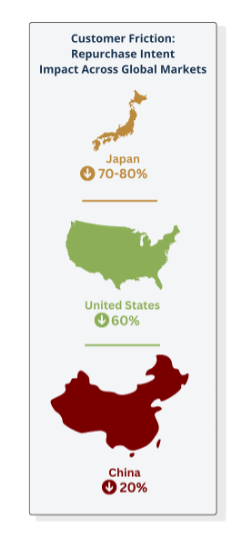
- Repurchase intent dropped approximately 60% when friction occurred.
- Effective resolution fully recovered lost loyalty, but only when customers were completely satisfied.
In Japan and International markets:
- Repurchase intent dropped 70–80% when friction occurred.
- Service recovery was less effective due to higher customer expectations.
In China:
- Repurchase intent dropped by only ~20% when friction occurred.
- Effective service recovery restored loyalty.
This demonstrated that empowering frontline teams to fully resolve issues represents one of the highest-return investments available.
4. Hidden Economic Risk
When financial data was matched back to survey responses:
- In the US, $53M of revenue from surveyed customers fell into the bottom three repurchase intent categories.
- In Japan, approximately $26M in revenue was associated with low repurchase intent customers when extrapolated.
- In International markets, roughly $34M in revenue was at risk.
While promoter scores appeared strong, repurchase intent revealed significantly higher economic exposure. This gap underscored the limitations of relying solely on NPS.
Introducing a Behavioral CX Index
To strengthen measurement rigor, The Verde Group introduced a proprietary CX Index built on three observable variables:
- Friction (problem incidence and severity)
- Service recovery effectiveness
- Customer engagement behaviors
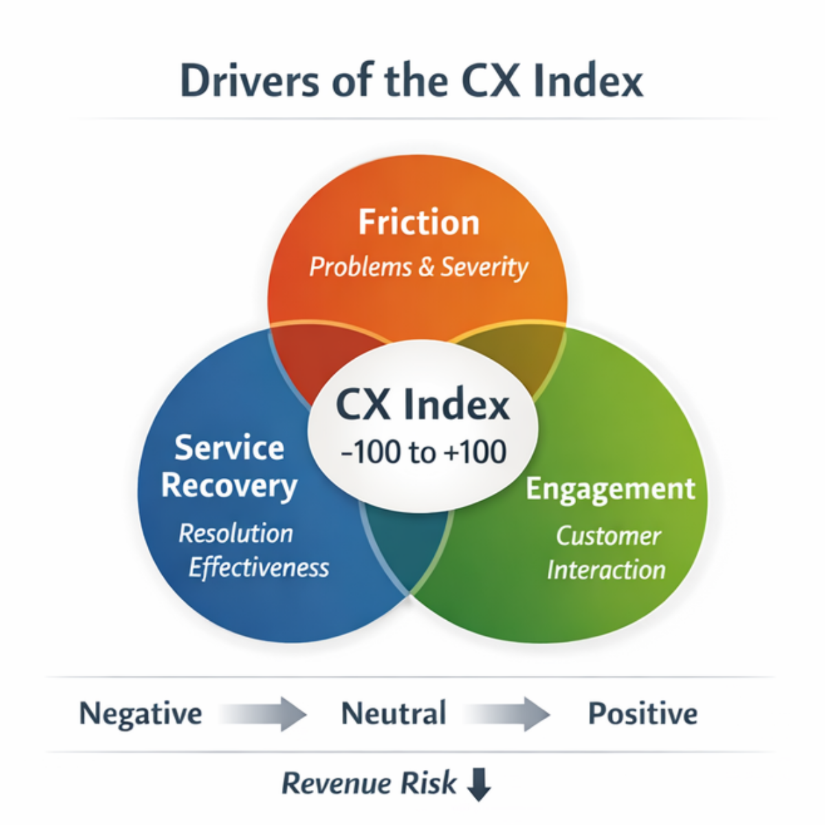
Each respondent was classified as Positive (+100), Neutral (0), or Negative (-100) based on behaviors rather than attitudes. Scores ranged from -100 to +100. This index:
- Reduced cultural bias
- Focused on operationally actionable drivers
- Provided a stronger linkage to financial performance
- Offered leadership a clearer health indicator
Japanese and Chinese markets showed significantly stronger CX Index performance than US and International markets, consistent with lower friction and reduced economic risk.
Strategic Impact for the Client
The program enabled leadership to:
- Quantify revenue at risk.
- Prioritize high-impact friction points.
- Align global and local teams around shared CX priorities.
- Shift from attitudinal metrics to behavioral measurement.
- Identify quick wins and longer-term strategic investments.
Rather than treating CX as a satisfaction initiative, the organization repositioned it as a growth and risk-mitigation strategy.
Outcomes & Next Steps
Based on the findings, leadership prioritized:
Short-Term Actions
- Improve frontline empowerment and issue resolution processes.
- Increase proactive post-sale relationship management.
- Enhance marketing and clinical support materials.
Mid-Term Actions
- Standardize global service recovery protocols.
- Increase customer engagement touchpoints.
- Align premium pricing with premium service delivery.
Long-Term Strategy
- Modify the go-to-market approach to ensure sales teams focus on revenue generation rather than ongoing day-to-day customer management.
- Institutionalize the CX Index as a core performance metric.
- Track CX performance relative to financial outcomes
- Create closed-loop feedback systems.
Conclusion
The Verde Group’s global CX research initiative transformed the organization’s understanding of loyalty risk. By moving beyond traditional satisfaction metrics and quantifying the behavioral drivers of repurchase intent, leadership gained clarity into where customer friction directly impacts financial performance. The program demonstrated that:
- Loyalty damage is measurable.
- Service recovery is a growth lever.
- Post-acquisition friction is the primary driver of risk.
- Behavioral CX metrics outperform attitudinal metrics.