
In conversations with leading CX practitioners, we hear it time and time again: They’re frustrated despite mountains of data being generated. They’re searching for ways to increase the meaning and importance of their work and make a difference in their business’s outcomes.
Why are they frustrated? What is driving this challenge? After all, the customer experience industry is growing rapidly. According to a 2023 Yahoo Finance article, the customer experience industry is expected to grow at a 7% compounded annual growth rate for the foreseeable future, reaching $120 billion by 2026. Even the U.S. economy would be envious of such a rapid trajectory.
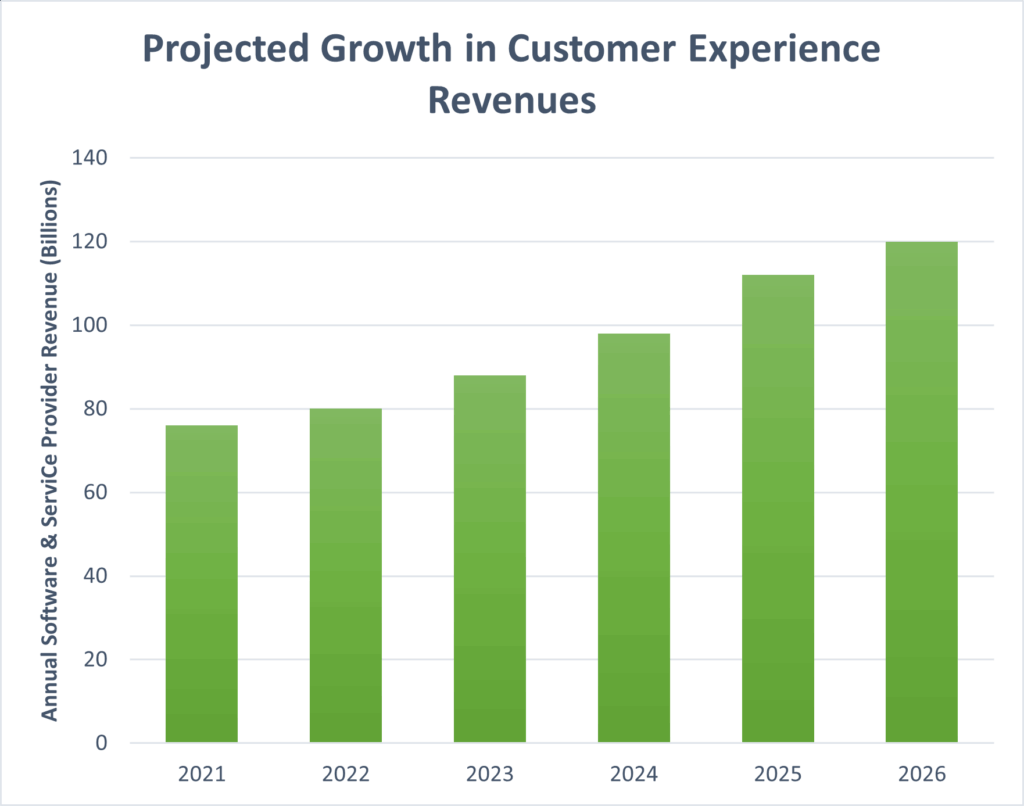
A key driver of the growth of the industry is the importance placed on improving the customer experience by Executive Leadership. This point is clearly demonstrated in Forrester’s 2023 customer experience study where 80% of businesses stated that improving their CX is a high priority. It makes sense. Who wouldn’t want to deliver a better experience to their customers? But there’s a catch…
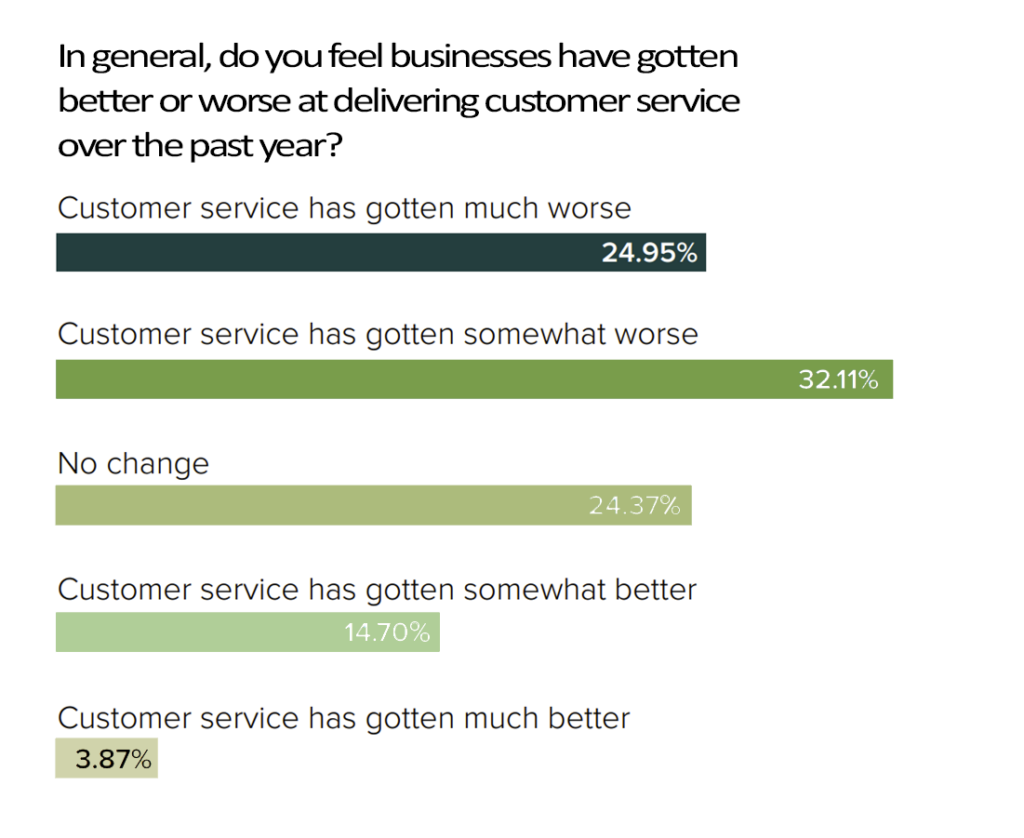
After investments in very bright people, dedication to process changes, and licensing of voice-of-customer insight technology, only 6% of businesses saw a significant increase in the performance of their customer experience. And it hasn’t gone unnoticed by the customer. According to a CCW survey, over half of customers stated that customer service has gotten somewhat or much worse this past year.
How is this possible? Companies are dedicating considerable resources to improve the everyday experiences their customers have with their brand, products, and services, yet progress is elusive.
Our Hypothesis: Organizations that use legacy CX research methods that do not clearly correlate with changes in customer behavior will continue to realize suboptimal business outcomes.
The Truth: CX Insights Are Not Consistently Used to Drive Business Decisions
There is a great debate going on across global boardrooms. Will investing in improving the customer experience truly yield improved business outcomes? Intuitively, one would think the answer is clear. Of course, a better experience should drive increases in revenue and profits. However, what part of the experience should companies focus on? What specific interactions should be triaged and improved? If investments have been made using existing insights, has the company realized improved financial outcomes? If not, why not? The hard truth is that customer experience strategy is complex. Sifting through all the noise to find a signal is a challenge, and let’s face it, focusing on improving one attitudinal metric is likely not impactful.
In a 2023 Verde Edition reader survey, we found that 66% of businesses are not consistently using CX insights to guide their decisions.
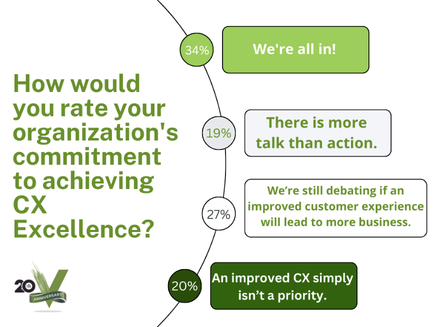
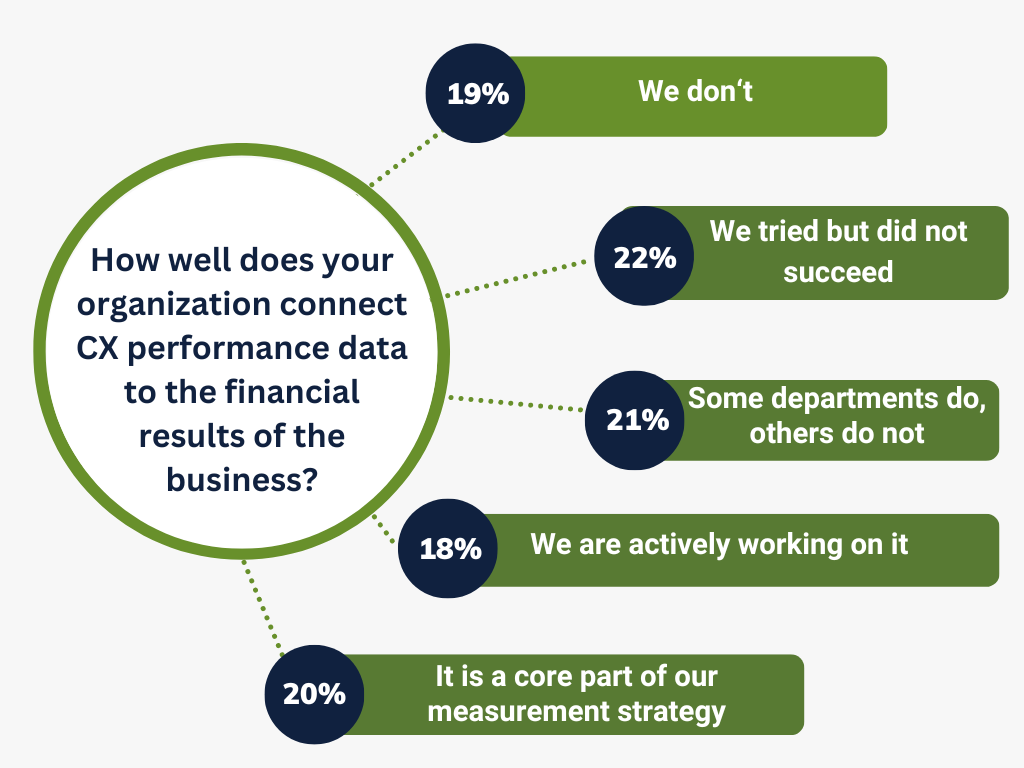
Why? Our belief is that organizations are not widely using CX insights to drive business decisions due to the lack of connection to their financial performance data. This was substantiated in a separate Verde Group survey: we found that only 20% of companies link CX insights to financial results.
Our perspective is in line with the great Thomas Edison who said:
“There is always a better way.”
An Alternative to Current CX Measurement Methods: A Look at E-A-B Experiences, Attitude, Behavior Model
Verde Group’s E-A-B model, which is at the core of our insight methodology, proposes that understanding experiences, not attitudes, is the key to unlocking CX insights. Elementally, you cannot change someone’s attitude. You can only change the experiences that created the attitudes in the first place. The E-A-B model is based on human motivation theory, which suggests that, as humans, we are “hard-wired” with a fight-or-flight response mechanism, an instinctive physiological response to a threatening situation that readies one to resist forcibly or run away when facing danger. Danger, in a CX context, could be described as friction. Therefore, experiences, especially CX friction, can be explicitly tied to a customer’s behavior. And as individuals, we are much more likely to predictably take action on negative experiences than positive ones. Dissatisfaction is the strongest predictor of an individual’s future behavior.
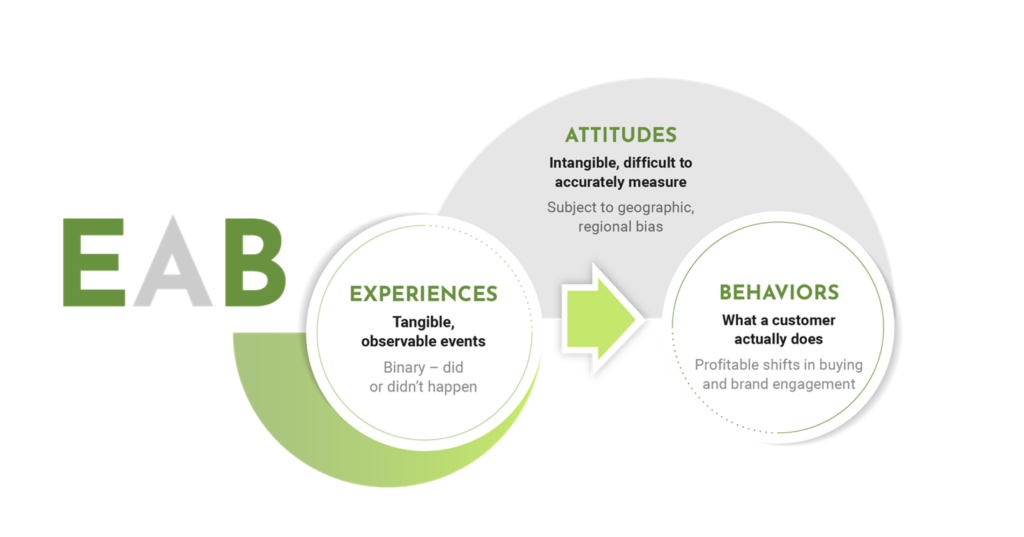
A focused approach to identifying if specific CX friction points have occurred and to whom they occurred can provide organizations a prioritized roadmap to future economic success.
Not All CX Problems Are Created Equal
Most companies we speak with have a general understanding of their problems or opportunities. This mindset is based on the persistent barrage of data, feedback, contact center logs, etc. The challenge is that this knowledge is based on the frequency of specific issue occurrence. While the frequency of occurrence is important, it is not the most important factor in determining if a problem is truly driving negative market action. Understanding the barriers that limit customers from purchasing goods and services, or engaging with a brand, serves several key points in the pursuit of linking CX insights to the economic performance of the enterprise. Those points are:
- Separates noise from signal – identifies the moments that matter
- Quantitatively prioritizes the magnitude of the friction – not just the frequency
- Serves as the basis for analysis – linking specific experiences to downstream behaviors
- Removes “opinions” and inserts financially grounded facts into CX insight discussions
- Creates a baseline business case for investment decisions in people, process and technology
The below chart highlights the difference between general CX friction problems and those most damaging to the enterprise. Notice that many frequently mentioned problems are simply not the most damaging. The most damaging points down the frequency spectrum often go unnoticed. These points are the “silent killers” of your business.
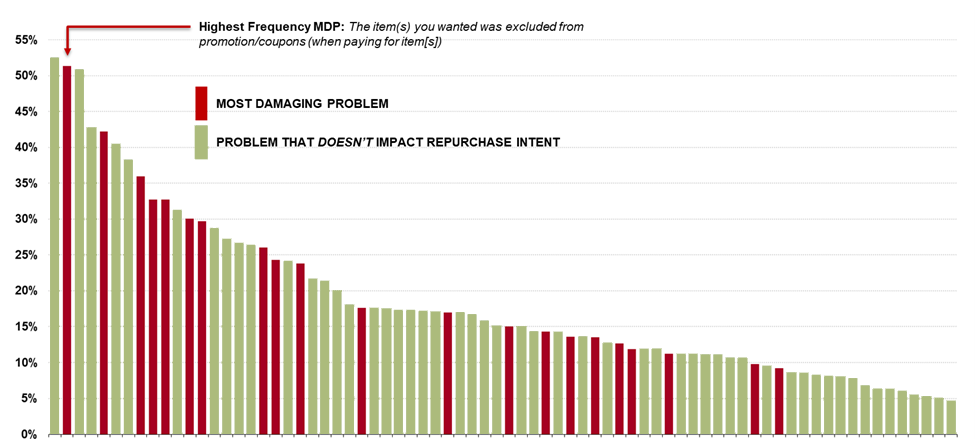
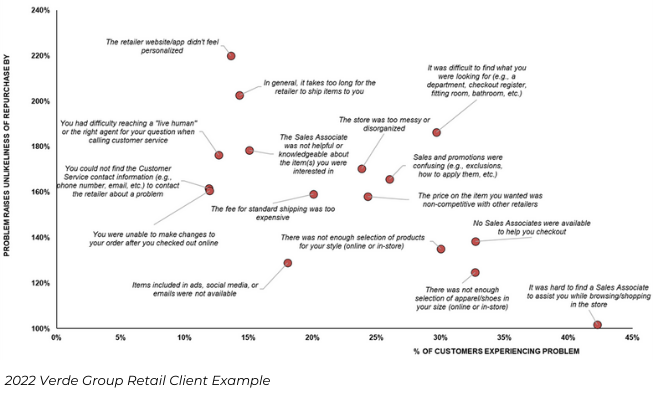
In this retail case study example, we call out the specificity of problem statements used as part of customer interrogation. The analysis helps companies identify which customer pain points they need to improve to grow customer loyalty, spend, and brand equity. Again, frequency does not equal impact.
The “Low-Hanging Fruit” of Understanding and Addressing CX Friction
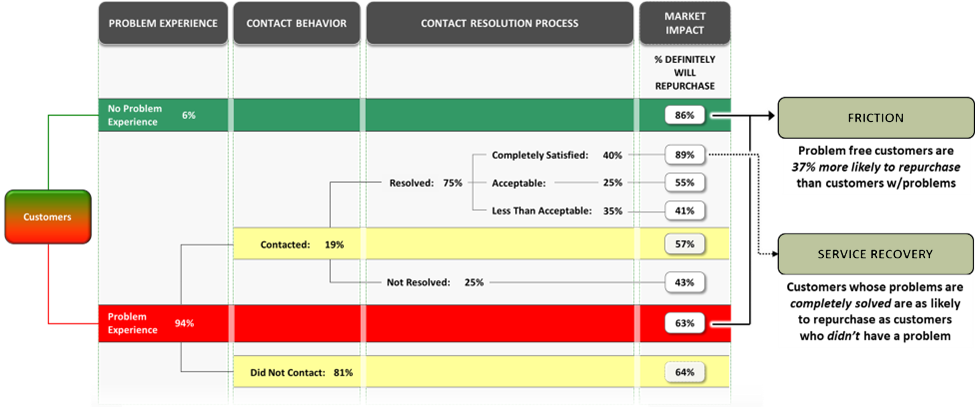
For over 20 years, Verde Group has assessed the impact of a strong service recovery program on a customer’s future intentions and more importantly, their behavior. This analysis has yielded similar results across a broad set of business categories and customer types. Consistently, we find the following:
- Most customers experience some friction during their interaction with a brand. It’s simply a fact that inevitably, things go wrong.
- Most customers do not tell you when a problem has occurred; this represents a great opportunity to rebuild loyalty and future revenues.
- Many companies make addressing a customer’s issue a challenge. This can be due to a lack of resources and/or autonomy and/or empowerment of front-line staff based on a strategic determination that sub-par or below average service recovery will not result in lost revenue
- Loyalty and future revenues increase significantly when issues are resolved to the complete satisfaction of the customer. This represents a hidden gem in a company’s ecosystem that if invested in properly, can result in significant economic upside
Verde Group Believes There Is a Better Way
Shifting your CX measurement and management approach can be daunting. Organizations have entrenched platforms, metrics, and belief systems that act as barriers to change. Couple this with compensation programs linked to CX performance, and you have a recipe for maintaining the status quo. But what if there is a better way? What if a new, more actionable approach would allow companies to clearly understand how specific moments of truth correlate to business outcomes?
Let’s face it. NPS and other attitudinal metrics, while widely adopted, have their challenges.

We believe there is a better approach…
Revenue@Risk®
The Verde Group’s Revenue@Risk® analysis directly addresses the shortfalls of legacy measurement programs. Revenue@Risk® prioritizes the financial impact of customer experience friction points. And it can be expressed in a singular metric (Revenue@Risk® Index) that we have seen outperform NPS as a predictor of future customer spend and value.
Revenue@Risk® explains:
- Revenue: Which customer experiences matter most to customer revenue growth?
- Actionability: What specific CX actions will improve satisfaction, loyalty, and market share?
- Voice of the Customer: How well is the brand delivering on key customer priorities, and what is the corresponding behavioral
impact of customers’ confrontation with key friction points?
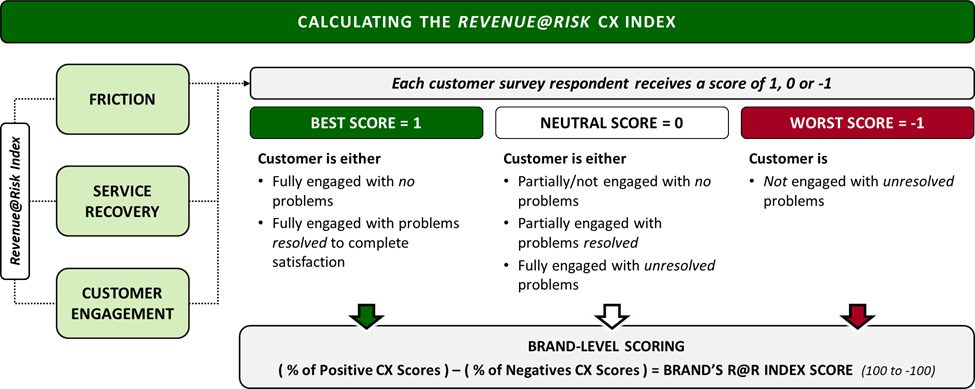
The Revenue@Risk® Index metric comprises three factors and is reported as an index value for the business. Those factors include:
- Friction: Are your customers experiencing pain in their relationship with you? How much? Which experiences are driving pain and hurting revenue? Explains most damaging problems: Out of all of your customer pain points, which specific critical issues inflict the greatest economic risk?
- Service Recovery: How well do you solve your customers’ pain when they reach out to you for assistance with an issue?
Explains efficacy of problem resolution: Across channels and customer-facing roles, are you recapturing loyalty at risk due to problem
experiences? - Customer Engagement: How engaged are your customers in their relationship with your company and your brand? Is their engagement active, passive, or a blend? Explains non-transactional engagement: How to grow both the passive and active entanglement of customers via “sticky” engagement tactics.
The Engagement component of the Revenue@Risk® Index measures how involved a customer is with your brand, and in what ways.
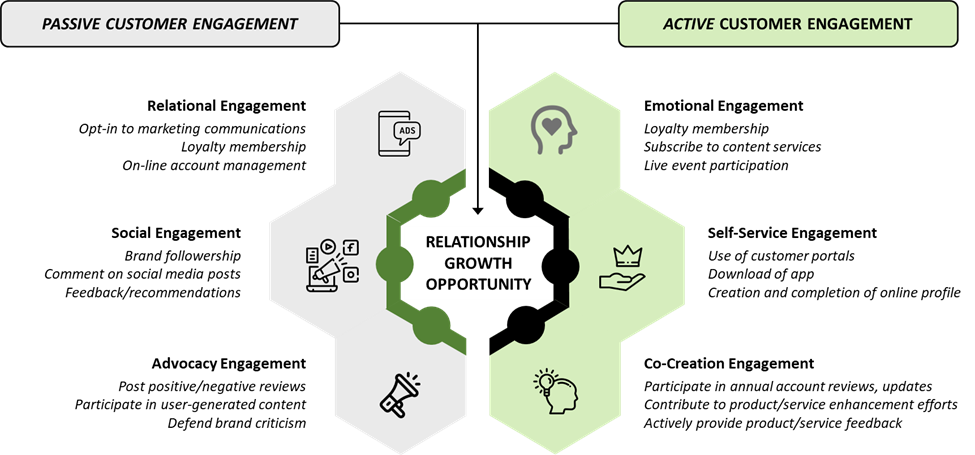
Like NPS, the Revenue@Risk® Index is a straightforward metric that is easy to calculate and easy to explain.
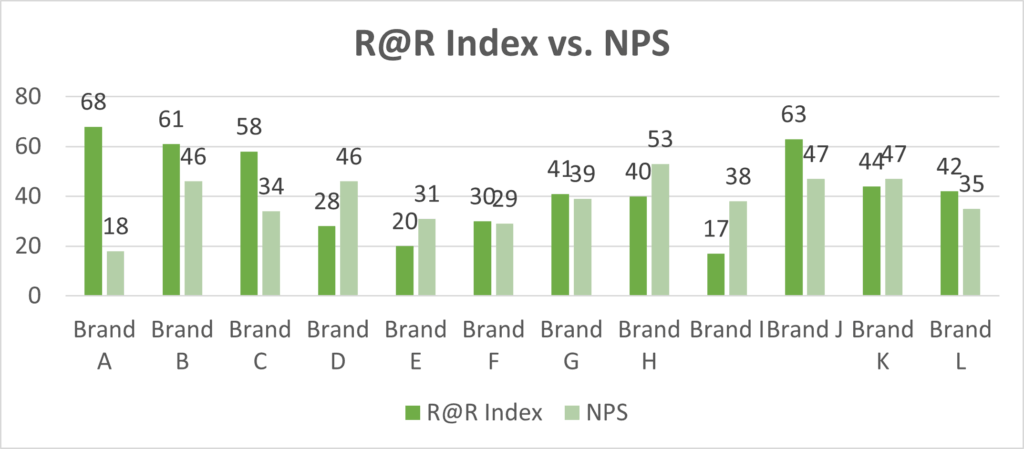
In this example you will note that the Revenue@Risk® Index cores are unique & differentiated vs. NPS for the brands studied.
And most importantly, demonstrate a stronger correlation to year-over-year changes in revenue.
Y Axis: Correlation to 36-Month Change in Revenue
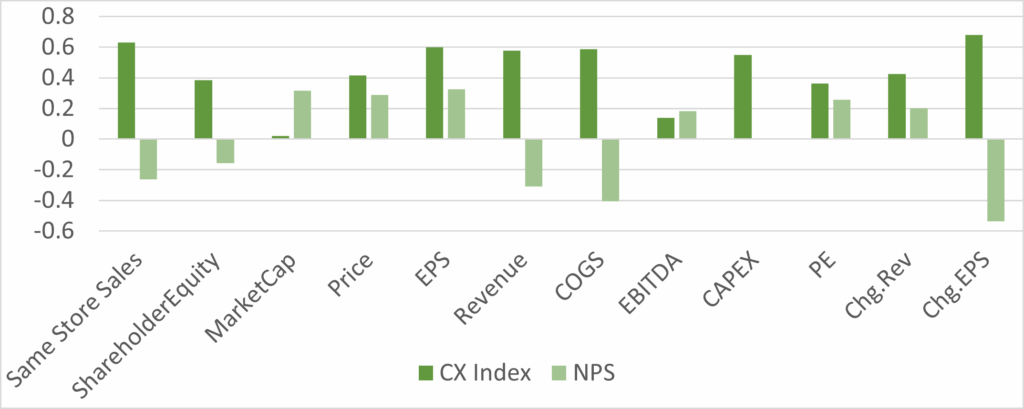
Unlike NPS, the Revenue@Risk® CX Index accurately predicts customer spend and directly links CX improvement efforts to revenue and share growth.
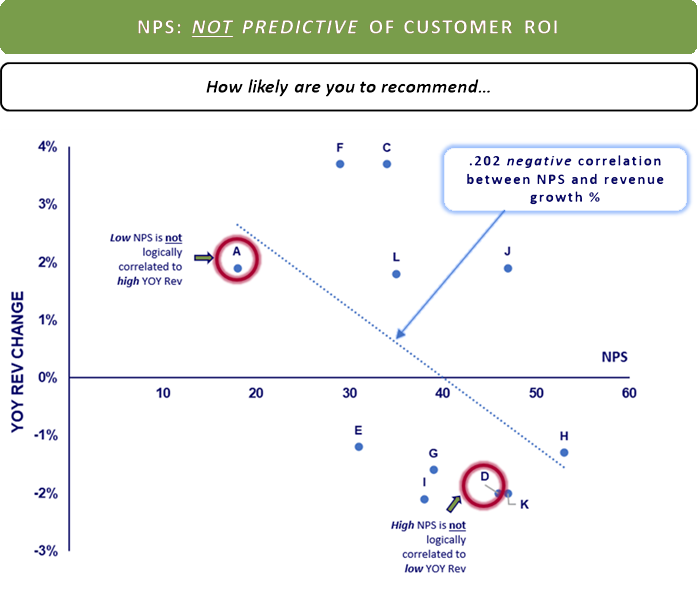
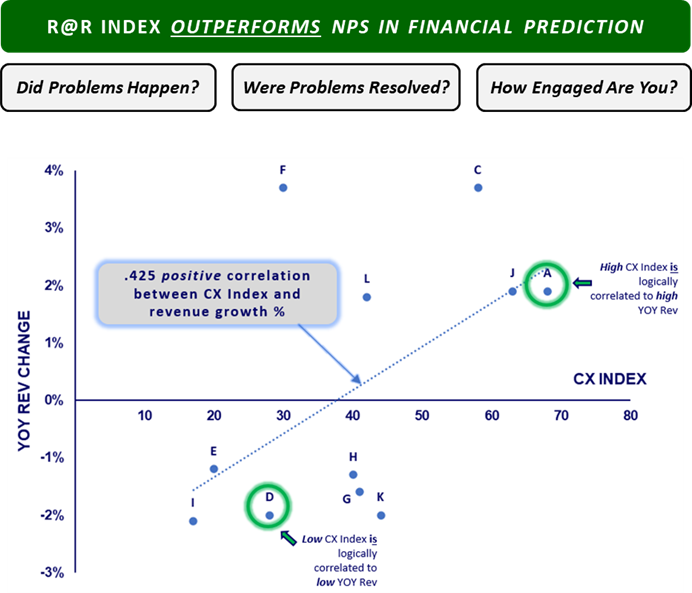
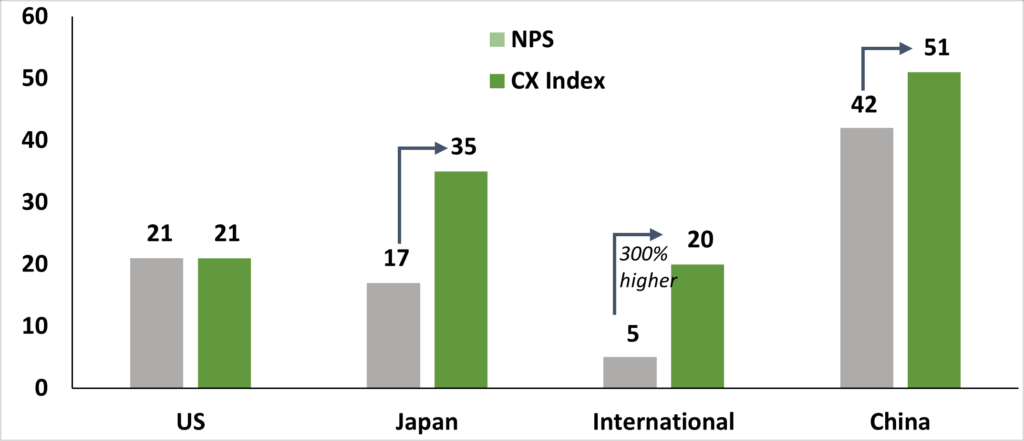
This is further demonstrated in a global B2B study where scalar research methods — like NPS — fall victim to cultural response bias.
Key Takeaways
-
Companies continue to invest in CX technology, research, and consulting services with sub- optimal progress toward achieving business results.
-
CX insights that are generated are not widely used by C-Suite Executives to make strategic investment decisions due to their lack of connection to business outcomes.
-
There is a better option: Understand the experiences (CX Friction) — not attitudes — to drive results, specifically those negative experiences that drive predictable downward market action.
-
Use a reliable beacon metric to elevate the strategic visibility and impact of ongoing CX insights.